Friday, October 28, 2005

Kates Playgroundo Face


HISTORY AND GEOMETRY


(I)


all started in Egypt
human beings need to have, and created the numbers, wanted to make calculations and operations defined, made relationships, and determined the numerical properties .
Through the above, plus the use of logic, he got the right tools to resolve problem situations encountered daily.
addition to these practical requirements, the man said to admire the beauty of creation to satisfy your spirit. To that end, observed nature and everything around him. This was devising concepts of forms, shapes, body lines, which gave rise to the part of mathematics which we designate by the name of geometry.


The Nile River

The word geometry is made up of Greek roots: "geo" earth, and "metron" measure, therefore, its meaning is "earth measure."
As history records, the geometric concepts that man devised to explain the nature born-in-a practical way the river Nile in ancient Egypt.
The main causes were having to highlight the limits of coastal land and building dams to channel the water side. This is due to the floods that caused periodic flooding. But the real reason was that the upper classes knew so much planted his subjects and then ... know how much to charge tax.

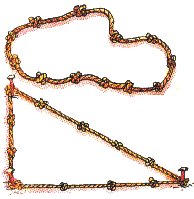
land to measure the Egyptians aprendierona acalculous the area of \u200b\u200brectangles and triánngulos. Triangles used to measure the string.


The Babylonians

The Babylonians also knew the areas triangles and rectangles models, especially to solve inheritance problems how to distribute the lands among heirs? They also saw areas of pentagons, hexagons and heptagon. But especially studied a lot of circles.


excellent surveyors were they baptized the twelve constellations of the zodiac, dividing each into 30 equal parts. That is, the zodiacal circle divided into 12 x 30 = 360 parts. Remember that they create the sexagesimal numbering system (base 60). This would serve to develop Zodiac calendarioa and almanac: very useful for growing cereals. This means that the geometry created with astronomy.

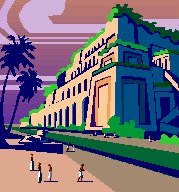

of them have inherited the division of circumference of 360 degrees and each degree into 60 minutes and each minute into 60 seconds. And the patent of our way of counting time is also yours.


Greeks


scientific Who gave the geometry were the Greeks, incorporating demonstrations based on reasoning.


Thales (600 BC) began this trend, to conceive of the possibility of explaining different geometric principles from simple and obvious truths. CRTEAN is born in Miletus, now Greece, (624 BC-?, 548 BC)

In his youth he traveled to Egypt where he learned geometry of the priests of Memphis, and astronomy, later taught under the name of astrosophy . He was a teacher of Pythagoras and Anaxímedes, and contemporary of Anaximander.

was the first Greek philosopher who attempted to give a physical explanation of the universe, which for him was a rational space despite its apparent disorder. However, did not seek a Creator in such rationality, since for him all born of water, which was the basic element that all things were made. Assumed that the earth floating in an infinite ocean.

In geometry, and based on the knowledge acquired in Egypt, developed a set of general theorems and deductive reasoning from these. This was compiled later by Euclid in his Elements but Such is due to the merit of having introduced into Greece the interest in geometric studies.

was the famous scholar of history fell miara a well by the stars and an elderly woman said "Prertendes observe the stars and do not even see what tienens your feet." also attributed to Thales the history of the mule that was carrying salt and got into the river to dissolve them and lighten their weight; These will remove the bad habit charging it with sponges.

When asked about the reward he wanted for his discoveries answered "I would consider myself well rewarded if others did not attribute my findings, but acknowledge that they are mine."

Pythagoras (582-496 BC) was a native of the island Samos, located in the Aegean Sea. At the time of this philosopher, the island was ruled by the tyrant Polycrates. As the free spirit of Pythagoras could not acquiesce to this form of government, he emigrated to the West, founded in Croton (southern Italy), an association that did not have the character of a philosophical school but a community religious.

For this reason, we can say that the mathematical sciences were born in the Greek world of a corporation in the religious and moral. They came together to perform certain ceremonies, to help each other, and even to live in community.

The Pythagorean School was allowed access to anyone, even women!. At that time, and for a long time and in many villages, women were not admitted to the schools. It is said that Pythagoras married one of the students: Theano.

The symbol of the School of Pythagoras, and by which they recognized each other, was the Pentagon crash, they called Pentalpha (five alphas). In this school was entered after taking the oath at number ten, all documents are kept in spoken and no one could publish them. Playing with stones and formed the square numbers and rectangular numbers. Pythagoras Thales met and became friends.

For the Pythagoreans, not only the earth was round, but did not occupy the center of the universe. The earth and planets revolved, while the sun-fire around the center or "heart of the Cosmos" (identified with the number one). The world sucks air mass that surrounds unlimited air and speaks as unlimited.

Due to the political influence that had the school at that time, an influence that was contrary to the existing democratic ideas, there was, perhaps, after the year 500 a revolt against them, being beaten and burned their homes. Pythagoras was forced to flee to Taranto, south Italy. Some think that a year later was killed in another popular uprising in Metaponto.

Pythagorean is due to the essentially deductive geometry and the logical sequence of their proposals, qualities that remain to this day. The basis of his philosophy was the science of numbers and the study of geometry. But Pythagoras is famous for having discovered the theorem that bears his name: the Pythagorean theorem. What is this theorem? Simple: the sides of a triangle square Formanoir.

And if we add the squares of the shorter sides of the squares get larger side (also known as the hypotenuse).

Demonstrations Pythagorean Theorem:

http://www.pajarita.org/aep/articulos/ARTIC6-2.PDF


Plato (4 27-348/347 BC) Aristocles Athens, nicknamed Plato (Plátwn = "that of broad-shouldered ") was born, probably, the year 428-427 BC in Athens, or perhaps in Aegina. Belonged to a family noble.El year 399 is the sentencing and death of Socrates. Fearing being bothered by their condition of friend and disciple of Socrates, Plato took refuge in Megara also traveled through Egypt, Sicily and Italy in the company of mathematician Eudoxus.

In the 387 returned to Athens and founded the Academy, the first organized school of philosophy, the origin of the current universities. There remain for twenty years devoted to studying and teaching. He placed at the entrance of the Academy, his famous and significant sentence: "Do not go here do not know geometry" . This and other proposals as "numbers rule the world."

According to Plato, the study of geometry should be started in the following order: 1.-Definiciones2.-Axiomas3.-Postulados4.-TeoremasA this directive Plato adapted mathematicians after him, mainly Euclid .

Platonic Solids, Platonic bodies, bodies cosmic Pythagorean solids or polyhedra of Plato (that all these names are) are characterized as geometric polyhedra convex whose faces are polygons regular equal and whose vertices join the same number of faces . There are five Platonic solids
different
The tetrahedron , four triangular faces;
The hexahedron , or hub, six square faces;
The octahedron , eight triangular faces;
The
dodecahedron , twelve pentagonal faces, and
The icosahedron , twenty triangular faces.

represent the five Platonic solids composition and harmony of things. In the Timaeus is said Earth is made of atoms grouped in the form of hexahedral, the fire tetrahedron, air, octahedron, and water of icosahedra. The entire universe is featured in the dodecahedron.

Want to "touch" these polyhedra on the web:

http://www.luventicus.org/articulos/03N023/index.html

also find the templates to cut and assemble!

go into more detail on the blog of polyhedra ...

Katesplaygrounf Uncensored


LA HISTORIA Y LA GEOMETRÍA
(II)


systematizing
- Euclid -


Little is known of the Greek mathematician, even some people think that in reality never existed, but his works belong to a group of Greek mathematicians who called himself by that name. Believed to have lived between fourth and third centuries before our era (330-275 BC) and worked in the Library of Alexandria. His great achievement was to gather and synthesize the knowledge of geometry of his time.
key
His book is called Elements, and originally consisted of thirteen volumes that set out the classical geometry. This book is so important to mathematics as the Principia of Newton for Physics and the Origin of Species Darwin for biology.


A page of its first printed edition

To lay the foundations of geometry, Euclid used what is called axioms, which are nothing more than unprovable principles but is considered obvious, and from which to build a theory. He called and made five key principles which can be stated in several equivalent ways, one of which is:

1. If we have two points, then we can draw a straight line
unites 2. Any line can do whatever you want
long 3. To draw a circle of any size around any point
4. All right angles are equal
5. If we have a line and a point outside it, we draw all the lines qe want to go through that point, but only one will be parallel to what we had.

All this seems obvious, but the great merit of Euclid was to deduce all the geometry of his time from the 5 principles. So much so, that classical geometry is called in his honor Euclidean or Euclidean geometry.

The fifth postulate was always controversial, many thought it was not an axiom but a theorem, ie, it appeared that it was not as paramount as the others and could be deduced from the other 4, and for centuries tried to find a way to do it. However, it turned out that was not possible.


-Euclidean geometries
- Lobachevsky -


took more than 2000 years until the problem was settled fifth postulate . It is believed that Karl Friedrich Gauss (1777 - 1885) was the first that was clear, but not someone like him, life was considered under one of the greatest mathematicians of all time, dared to publish their findings, since they broke with ancient dogma. Yes

dared a contemporary, Russian Nicolai Lobachevsky (1792-1856), who in 1826 not only said that the fifth axiom of Euclid could not be deduced from the other four, but it was not such an axiom. That axiom could be replaced by another and build a whole different geometry. However, the work did not achieve much impact Lovachevski beyond his inner circle, in the remote University of Kazan, a city belonging to the equally remote Russian republic of Tatarstan.


several different geometries, giving rise to classical, even a student of Gauss, Georg Bernhard Riemann (1826 - 1866) developed a geometry in which there are no parallel lines. Riemann himself later summed up the study of non-Euclidean geometries, called today in her honor Riemannian geometry.


CAN EXIST non-Euclidean geometries?

may seem strange to imagine geometries in non-compliance with the postulates of Euclid, but is an example that can help us to imagine, just think of a sphere, such as a soccer ball or about our planet Earth. If we draw a line on this area, it can not be infinite as in a plane, since it will end up returning to the same extent, and therefore its size is the diameter of the sphere, ie we will not have lines in the traditional sense but we have circles that serve the same function that the lines in traditional geometry.


In a field geometry is not as in a plane

This issue the area was known, of course, long time ago but nobody had put a serious study, it was felt that they were just degenerate cases of Euclidean geometry. However, since the nineteenth century geometries are considered as valid as the classic, and we can say that there are infinite possible geometries, depending on the curvature of the surface that we are dealing with. Euclidean geometry is the only case that is part of a plane, ie, when the curvature is zero.


GEOMETRY AND RELATIVITY
- ALBERT EINSTEIN -


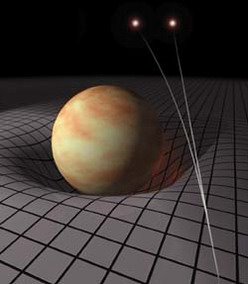
remember that we live in a universe of four dimensions, the three spatial dimensions plus time. This issue of the curvature of space-time can be more easily imagine a case on two-dimensional universe, ie a plane, like maybe a mattress. If the mattress is placed a marble, this will remain quiescent. But if after the marble put a heavier object, like a big ball of iron, this sink (bend) the mattress so that the marble will tend to approach the iron ball.


space curves around the bodies

can say that the curvature of the mattress is an example of two dimensions of how the Earth warps the space around drawing to objects.

and went to find the performance of this curved space devoted to what Einstein eight years. The complex resulting equations can be summarized as follows: The curvature of space-time in an area of \u200b\u200bthe universe is equal to the mass and energy content of that region.

geometry underlying this curve is that of Euclid, but a non-Euclidean representing consequences that give different explanations for phenomena hitherto believed understood. For example, the planets revolving around the sun are actually describing a straight line, but as we saw before, a line in a non-Euclidean space is different from the straight life.


FUTURE PROBLEMS
- D. HILBERT -


German mathematician. During the nineteenth century revealed, "ever more evident that Euclid had no party patents and concepts that had gone much unspecified. Efforts were made to set a minimum number of terms and basic definitions of these unidentified and rigorously derive the mathematical structure complete.

This science is axiomatic, and were Hilbert and Peano who founded it. Hilbert published in 1899 "Foundations of Geometry" (Foundations of Geometry), which was first successfully exhibited a series of axioms of geometry. Hilbert was content to define certain properties instead of defining them. It also showed that the system of axioms was quite complete, something that the Greeks had accepted the axioms of Euclid, but without proof. Thus Euclid's work completed without changing the essence, but his foundation went from intuitive sense.

is famous lecture delivered at the International Congress of Mathematicians in Paris in 1900, entitled Mathematical Problems in proposing A list of 23 issues that were unresolved (some still are).

One of these questions was: What is mathematics decidable? ie is there a defined method that can be applied to any mathematical statement and tell us if that statement is true or not?. This matter was called enstcheidungsproblem and to resolve,
Alan Turing built in 1936, a formal model of computer, the Turing machine and showed that there were problems such that a machine could not solve.

Two questions: What is the complete mathematical?, Ie, can be proved or disproved any mathematical statement? and what mathematics is consistent, "that is, is it true that statements such as 0 = 1 can not be proved by valid methods?. In 1931,
Kurt Gödel was able to answer these two questions, showing that any sufficiently powerful formal system is inconsistent or incomplete.

invariant Hilbert worked on algebraic geometry (his book The Foundations of Geometry is a classic), integral equations, also devoted to physics (say that physics is too difficult for physicists), his book Methods of Mathematical Physics, by Richard Courant and David Hilbert (known as the Courant-Hilbert) is still printed today, and also Work on the foundations of mathematics and mathematical logic.

Hilbert's epitaph is "Wir müssen wissen, wir werden wissen" ("We know so that we know")

Wednesday, October 26, 2005

Funny Guest Book Ideas For Wedding


INTRODUCTION
THE GEOMETRY


indefinite
OF GEOMETRY:
(POINT, LINE AND PLANE)


POINT
A point has only location in space.
is the indivisible unity of geometry.
not have dimension (length, height, width)


ONLINE
Online is a geometric figure that is generated by a moving point.


STRAIGHT
If the point moves without changing direction, then it is a straight line.


IS THE INFINITE IS STRAIGHT?
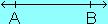
course the lines are endless so in geometry trbaja with "pieces" or "pieces" of a line called: line segments.


HOW TO JOIN TWO POINTS?
To join two points, we can use many different types of lines. Of these, the shorter the straight line. A line consists of infinite points and has no beginning or end.


CURVE ONLINE
If the point is constantly changing direction then it is a curved line.


A line can be straight, curved or in combination. Any line can be extended without limit .


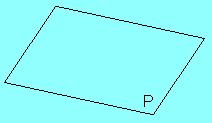
PLANE A plane is a surface that has length and width but no thickness.

The plane has two dimensions Unlike most cases that are around us in three dimensions.


studied plane geometry such as triangles, quadrilaterals, circle, circle ...
In other words studied plane geometry plane figures (polygons).


Cartesian diagrams


These diagrams were created by Rene Descartes, also known as Descartes, hence these diagrams are called Cartesian diagrams denominated.

A Cartesian plot is to divide the plane into four parts called quadrants by two perpendicular lines (horizontal and vertical respectively). These lines intersect at a point called the origin of coordinates.

These lines are named: the horizontal line (called "horizontal axis" or "x-axis) and the vertical line (called" vertical axis "or" y-axis ").

What is an ordered pair?


Here is an example in the figure above: the point of coordinates (2.3) is located placing us at the point marked with 2 in the axis "x" and once here, we went straight up parallel to the axis "y", to the place marked on the shaft 3, that is the point sought.


What is a Cartesian product?

If we have two sets A and B, and try to assemble all possible pairs formed by an element of set A and an element of set B, we get the Cartesian product of two sets. It is written:


can be represented in different ways: diagrams of arrows, diagrams, trees, tables and graphs Cartesian. Each pair we form with an element of A and one B, in that order, called the ordered pair.


ANGLES

The word angle comes from word "knee" in Greek.

An angle is the portion of the plane bounded by two rays originating from the same point. The rays are called initial and final hand. The common origin is called the vertex of the angle. An angle can be located anywhere in the plane, but sometimes it will be useful to move to a Cartesian coordinate system so that the vertex of the angle falls on the origin of coordinates and the initial side on the positive axis of abscissas.

Two rays form an angle. The point is the vertex.


The angle is denoted by one letter the Greek alphabet.

know the Greek alphabet:

http://personal5.iddeo.es/ztt/pra/alfabeto_griego.htm

kind of angle

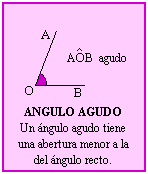
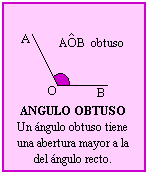
The angle is 90 ° is called the rectum. Which is less than 90 degrees is a sharp Angil which is larger than 90 ° is an obtuse angle. Angles measure 180 degrees flat.

But you can measure angles with your fist do not you think? Click on:

http://www.experimentar.gov.ar/newexperi/NOTAS/planetatierra/lunaexploracion.htm

the sexagesimal

To measure the angles used the sexagesimal system what cocnsiste this system?. This system was known in ancient Babylon, and consists of dividing a circle into 360 equal parts. Each of these parts is called degree (º). A quarter, or one quadrant, measured 90 ° Easy! No?

To measure the angles used conveyor.

But you can make a "paper carrier" that will serve you in cases emergency, to measure some angles. OK.

http://www.cientec.or.cr/matematica/origami/transportador.html


Building a

geoboard

Tupuedes touch the lines and build their own sites and con0ocer the areas of squares, rectangles and triangles ... just build a geoboard.

need a table of about 30x30 cm. You have to do with a pencil, a grid on the table (6x6, 7x7x, 8x8, depending on size of timber you have.) Then you have to put a nail in each of the intersections. Now you can build the sites you want to color links ... That's it! Simple and very useful!


virtual geoboard Download:

http://www .colombiaaprende.edu.co/html/mediateca/1607/article-73593.html

You must have Win Zip program.
Tuesday, October 18, 2005

My Stomach Expands When I Eat


Polygons


polygons polygons can be classified into regular and irregular polygons.


REGULAR POLYGONS


A regular polygon is a flat, closed figure formed by joining three or more line segments. A polygon regular is that the sides and interior angles are all equal.

Construct regular polygons!


http://www.cnice.mecd.es/Descartes/1y2_eso/Poligonos_regulares_y_circulos/Policir1.htm


Quadrilaterals

Quadrilaterals (4-sided figures) are:


SQUARE The formula for the area of \u200b\u200bthe square is
AREA = side side = l2 ·


THE RECTANGLE
The formula for the area of \u200b\u200bthe rectangle is AREA =
· hand side b = a ·


The parallelogram
The formula for the area of \u200b\u200bthe parallelogram is
AREA = base · Height = b • h

Play with the ring:

http:/ / www.cnice.mecd.es/Descartes/3_eso/Figuras_geometricas_del_plano/figugeo1.htm

THE TRIANGLES

Triangles are figures of three sides, are classified as:

Triágulo equilateral


isosceles triangle


triangle

Play triangles:

http://www.cnice.mecd.es/Descartes/3_eso/Figuras_geometricas_del_plano/figugeo2.htm

And the area of \u200b\u200ba triágulo?

Maybe you have already noticed that a square, to be "party" for one of its diagonals, can be divided into two equal triangles.

And if we divide a resctángulo by one of its diagonals we get two equal triangles.

Therefore the area of \u200b\u200ba triangle is:

hand side X / 2

Or written another way:

b X h / 2 (base x height divided by 2)

THE PENTAGON

THE HEXAGON

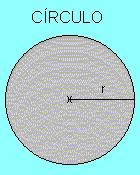
CIRCLE

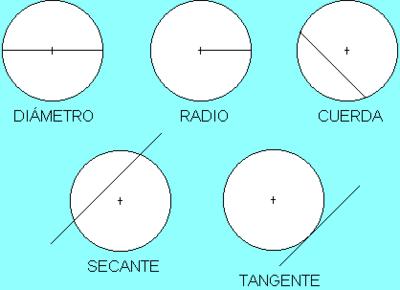
is the locus of all points up this figure and equidistant from a point called the center of the circle.

The circle is the geometric figure (the plane) and the circumference is the line that encloses the circle:


Inside the circle are the following figures:


The area of \u200b\u200bthe circle is:

And what does π ?


π (pi) = circumference / diameter


π (pi) is inall circles and its approximate value is 3.1416

regular polygons can be inscribed in a circle. See:

http://descartes.cnice.mecd.es/1y2_eso/Poligonos_regulares_y_circulos/Polici5.htm

Want to see the angles in a circle? Give it a click to:

http://www.cnice.mecd.es/Descartes/Geometria/Angulos_en_la_circunferencia/Angulos_circunferencia.htm

Major regular polygons

Stars made with polygons

THE IRREGULAR POLYGONS

As its name implies, are FIGS flat with no equal sides.

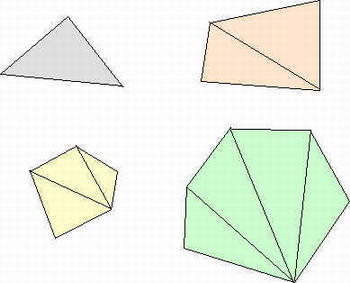
All irregular polygon can be subdivided into triangles:


And, of course, for find the area of \u200b\u200birregular polygons simply find the area of \u200b\u200btriangles that make up and then add these area. Simple! No?

THE PERIMETER

To find the perimeter of polygons (REGULAR and irregular) just add the length of its sides.