LA HISTORIA Y LA GEOMETRÍA
systematizing

Little is known of the Greek mathematician, even some people think that in reality never existed, but his works belong to a group of Greek mathematicians who called himself by that name. Believed to have lived between fourth and third centuries before our era (330-275 BC) and worked in the Library of Alexandria. His great achievement was to gather and synthesize the knowledge of geometry of his time.
key
His book is called Elements, and originally consisted of thirteen volumes that set out the classical geometry. This book is so important to mathematics as the Principia of Newton for Physics and the Origin of Species Darwin for biology.

A page of its first printed edition
1. If we have two points, then we can draw a straight line
unites 2. Any line can do whatever you want
long 3. To draw a circle of any size around any point
4. All right angles are equal
5. If we have a line and a point outside it, we draw all the lines qe want to go through that point, but only one will be parallel to what we had.
All this seems obvious, but the great merit of Euclid was to deduce all the geometry of his time from the 5 principles. So much so, that classical geometry is called in his honor Euclidean or Euclidean geometry.
The fifth postulate was always controversial, many thought it was not an axiom but a theorem, ie, it appeared that it was not as paramount as the others and could be deduced from the other 4, and for centuries tried to find a way to do it. However, it turned out that was not possible.
-Euclidean geometries

took more than 2000 years until the problem was settled fifth postulate . It is believed that Karl Friedrich Gauss (1777 - 1885) was the first that was clear, but not someone like him, life was considered under one of the greatest mathematicians of all time, dared to publish their findings, since they broke with ancient dogma. Yes
dared a contemporary, Russian Nicolai Lobachevsky (1792-1856), who in 1826 not only said that the fifth axiom of Euclid could not be deduced from the other four, but it was not such an axiom. That axiom could be replaced by another and build a whole different geometry. However, the work did not achieve much impact Lovachevski beyond his inner circle, in the remote University of Kazan, a city belonging to the equally remote Russian republic of Tatarstan.
several different geometries, giving rise to classical, even a student of Gauss, Georg Bernhard Riemann (1826 - 1866) developed a geometry in which there are no parallel lines. Riemann himself later summed up the study of non-Euclidean geometries, called today in her honor Riemannian geometry.
CAN EXIST non-Euclidean geometries?
may seem strange to imagine geometries in non-compliance with the postulates of Euclid, but is an example that can help us to imagine, just think of a sphere, such as a soccer ball or about our planet Earth. If we draw a line on this area, it can not be infinite as in a plane, since it will end up returning to the same extent, and therefore its size is the diameter of the sphere, ie we will not have lines in the traditional sense but we have circles that serve the same function that the lines in traditional geometry.
In a field geometry is not as in a plane
This issue the area was known, of course, long time ago but nobody had put a serious study, it was felt that they were just degenerate cases of Euclidean geometry. However, since the nineteenth century geometries are considered as valid as the classic, and we can say that there are infinite possible geometries, depending on the curvature of the surface that we are dealing with. Euclidean geometry is the only case that is part of a plane, ie, when the curvature is zero.
GEOMETRY AND RELATIVITY

remember that we live in a universe of four dimensions, the three spatial dimensions plus time. This issue of the curvature of space-time can be more easily imagine a case on two-dimensional universe, ie a plane, like maybe a mattress. If the mattress is placed a marble, this will remain quiescent. But if after the marble put a heavier object, like a big ball of iron, this sink (bend) the mattress so that the marble will tend to approach the iron ball.
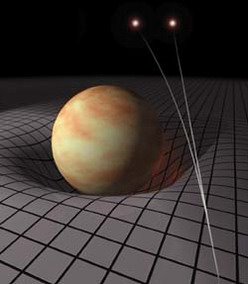
space curves around the bodies
can say that the curvature of the mattress is an example of two dimensions of how the Earth warps the space around drawing to objects.
and went to find the performance of this curved space devoted to what Einstein eight years. The complex resulting equations can be summarized as follows: The curvature of space-time in an area of \u200b\u200bthe universe is equal to the mass and energy content of that region.
geometry underlying this curve is that of Euclid, but a non-Euclidean representing consequences that give different explanations for phenomena hitherto believed understood. For example, the planets revolving around the sun are actually describing a straight line, but as we saw before, a line in a non-Euclidean space is different from the straight life.
FUTURE PROBLEMS
German mathematician. During the nineteenth century revealed, "ever more evident that Euclid had no party patents and concepts that had gone much unspecified. Efforts were made to set a minimum number of terms and basic definitions of these unidentified and rigorously derive the mathematical structure complete.
This science is axiomatic, and were Hilbert and Peano who founded it. Hilbert published in 1899 "Foundations of Geometry" (Foundations of Geometry), which was first successfully exhibited a series of axioms of geometry. Hilbert was content to define certain properties instead of defining them. It also showed that the system of axioms was quite complete, something that the Greeks had accepted the axioms of Euclid, but without proof. Thus Euclid's work completed without changing the essence, but his foundation went from intuitive sense.
is famous lecture delivered at the International Congress of Mathematicians in Paris in 1900, entitled Mathematical Problems in proposing A list of 23 issues that were unresolved (some still are).
One of these questions was: What is mathematics decidable? ie is there a defined method that can be applied to any mathematical statement and tell us if that statement is true or not?. This matter was called enstcheidungsproblem and to resolve, Alan Turing built in 1936, a formal model of computer, the Turing machine and showed that there were problems such that a machine could not solve.
Two questions: What is the complete mathematical?, Ie, can be proved or disproved any mathematical statement? and what mathematics is consistent, "that is, is it true that statements such as 0 = 1 can not be proved by valid methods?. In 1931, Kurt Gödel was able to answer these two questions, showing that any sufficiently powerful formal system is inconsistent or incomplete.
invariant Hilbert worked on algebraic geometry (his book The Foundations of Geometry is a classic), integral equations, also devoted to physics (say that physics is too difficult for physicists), his book Methods of Mathematical Physics, by Richard Courant and David Hilbert (known as the Courant-Hilbert) is still printed today, and also Work on the foundations of mathematics and mathematical logic.
Hilbert's epitaph is "Wir müssen wissen, wir werden wissen" ("We know so that we know")


0 comments:
Post a Comment