polygons polygons can be classified into regular and irregular polygons.
REGULAR POLYGONS
A regular polygon is a flat, closed figure formed by joining three or more line segments. A polygon regular is that the sides and interior angles are all equal.
Construct regular polygons!
http://www.cnice.mecd.es/Descartes/1y2_eso/Poligonos_regulares_y_circulos/Policir1.htm
Quadrilaterals
Quadrilaterals (4-sided figures) are:
SQUARE The formula for the area of \u200b\u200bthe square is
AREA = side side = l2 ·

THE RECTANGLE
The formula for the area of \u200b\u200bthe rectangle is AREA =
· hand side b = a ·

The parallelogram
The formula for the area of \u200b\u200bthe parallelogram is
AREA = base · Height = b • h

Play with the ring:
http:/ / www.cnice.mecd.es/Descartes/3_eso/Figuras_geometricas_del_plano/figugeo1.htm
THE TRIANGLES
Triangles are figures of three sides, are classified as:

Triágulo equilateral

isosceles triangle

triangle
Play triangles:
http://www.cnice.mecd.es/Descartes/3_eso/Figuras_geometricas_del_plano/figugeo2.htm
And the area of \u200b\u200ba triágulo?
Maybe you have already noticed that a square, to be "party" for one of its diagonals, can be divided into two equal triangles.

And if we divide a resctángulo by one of its diagonals we get two equal triangles.
Therefore the area of \u200b\u200ba triangle is:
hand side X / 2
Or written another way:
b X h / 2 (base x height divided by 2)
THE PENTAGON 
THE HEXAGON 
CIRCLE
is the locus of all points up this figure and equidistant from a point called the center of the circle.
The circle is the geometric figure (the plane) and the circumference is the line that encloses the circle:
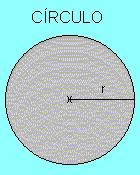

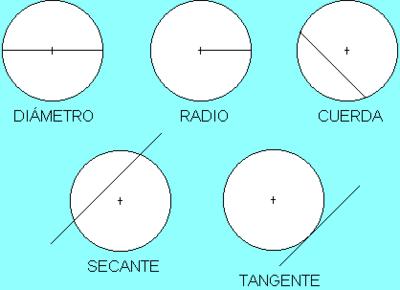
Inside the circle are the following figures:
The area of \u200b\u200bthe circle is:

And what does π ?
π (pi) = circumference / diameter
π (pi) is inall circles and its approximate value is 3.1416
regular polygons can be inscribed in a circle. See:
http://descartes.cnice.mecd.es/1y2_eso/Poligonos_regulares_y_circulos/Polici5.htm
Want to see the angles in a circle? Give it a click to:
http://www.cnice.mecd.es/Descartes/Geometria/Angulos_en_la_circunferencia/Angulos_circunferencia.htm
Major regular polygons


Stars made with polygons
THE IRREGULAR POLYGONS
As its name implies, are FIGS flat with no equal sides.
All irregular polygon can be subdivided into triangles:

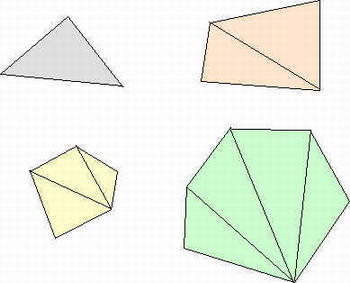
And, of course, for find the area of \u200b\u200birregular polygons simply find the area of \u200b\u200btriangles that make up and then add these area. Simple! No?
THE PERIMETER
To find the perimeter of polygons (REGULAR and irregular) just add the length of its sides.


0 comments:
Post a Comment